
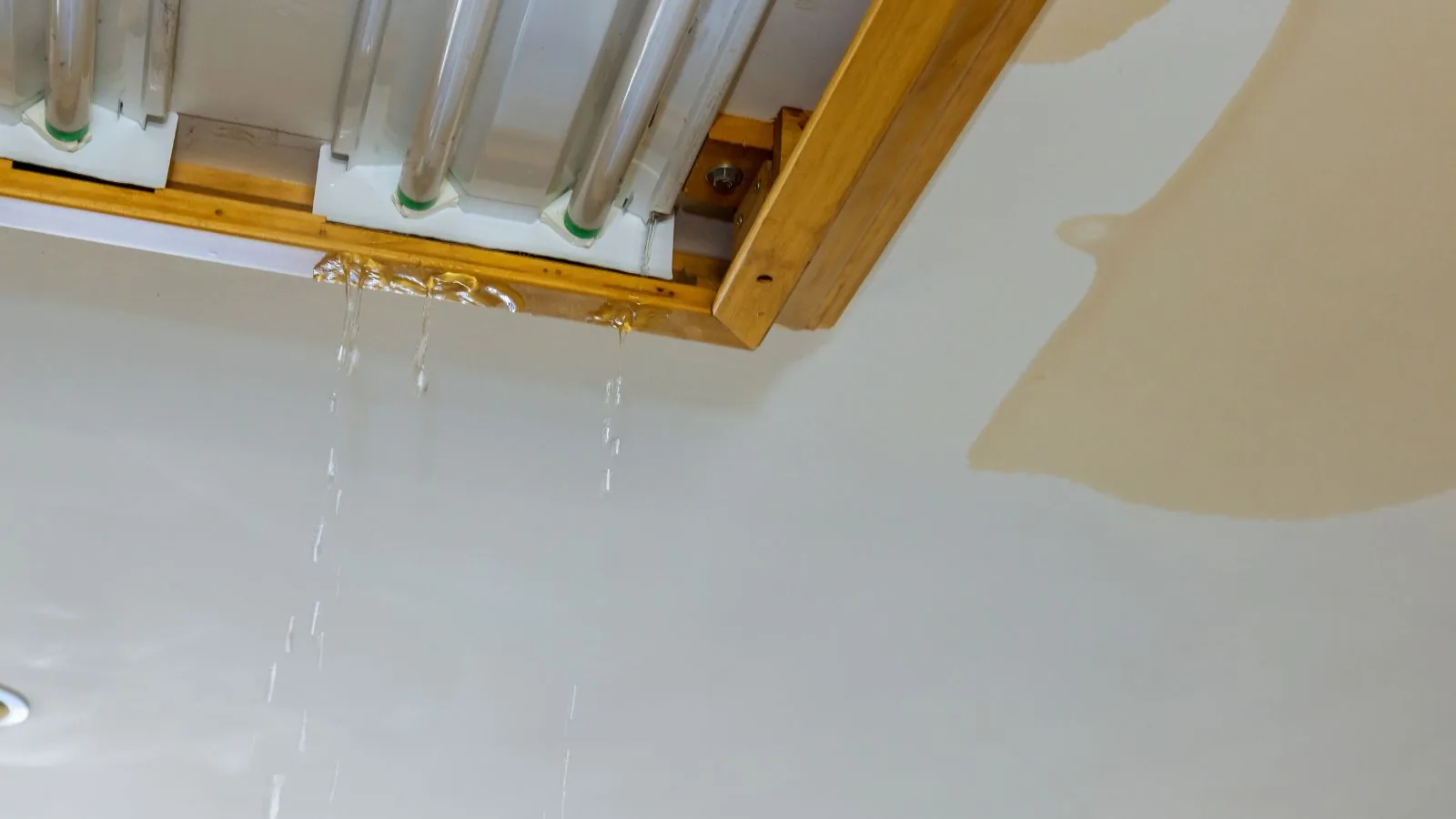
Water damage rarely announces itself with a flood. More often it shows as a small change that is easy to dismiss, such as a faint stain, a stubborn smell or a baseboard that has started to lift. Catching those signs early can be the difference between drying a wall and rebuilding it.
Stains and discoloration
Brown, yellow or tan stains on ceilings and walls are the classic sign. They often have a darker ring at the edge where the water stopped spreading. A stain that grows or reappears after painting means the source is still active.
Stains on a ceiling may point to a roof leak, an attic pipe or an air conditioning drain pan, and our ceiling water damage repair page explains the next steps.
Paint and wallpaper changes
Bubbling, blistering or peeling paint suggests moisture behind the surface. Wallpaper that curls at the seams or pulls away from the wall is another indicator. Efflorescence, a white powdery deposit, can appear on masonry where water has passed through.
Smells
A musty, earthy smell without an obvious cause can mean moisture trapped in a wall, under a floor or in a closet. Smells are worth following. The source may be behind a cabinet, in an attic or under carpet.
Soft, swollen or warped materials
Drywall that feels soft or crumbles, baseboards that swell and doors that stick can all point to water. Wood floors that cup or buckle, laminate that lifts at the seams and vinyl that curls at the edges show water at work. Cabinets under sinks may sag or show dark stains at the base.
Sounds and sights
Hearing water run when nothing is on, noticing drips in an attic or seeing damp spots on the ground near the foundation are direct signs of a leak.
Seeing these signs and not sure why? Call to talk it through.
Bills and meters
A water bill that rises without a change in use is a warning. A water meter that keeps moving after every fixture is off confirms a leak somewhere between the meter and the house or inside it. A warm spot on a floor can point to a hot water line under a slab, a case our slab leak page describes.
Mold and mildew
Visible mold or mildew, especially in corners, around windows and under sinks, means moisture is present. Mold needs moisture, so removing growth without finding the water is a short-term fix. Questions about health effects belong with a physician.
Where to look
- Under sinks and around toilets.
- Behind and under washing machines, dishwashers and refrigerators.
- Around the water heater and in the attic near the air handler.
- Along exterior walls below windows.
- On ceilings under bathrooms and roof penetrations.
What to do when you find a sign
Find and stop the source if you can, take dated photographs and dry the area quickly. If the material is soft or the stain is large, call a professional for moisture readings. Do not paint over a stain until the cause is fixed and the area reads dry.
Use your senses together
No single sign proves a leak, but several together make a strong case. A musty smell, a stain and a cool, soft patch on the wall point to the same place. Walk through the house slowly once a month and look, touch and smell in each room. Small changes are easier to catch when you know what normal looks like.
Track what you find
Mark the edge of a stain with a pencil and write the date. If the stain grows, the leak is active. If it does not, it may be old. That simple test costs nothing and gives a professional useful information.
A professional confirms these signs with moisture readings and classifies the water under the ANSI/IICRC S500 standard for water damage restoration.
A Dickinson note: rainfall and humidity
Dickinson has a humid subtropical climate, and Wikipedia reports that the town and surrounding areas receive about 57 to 61 inches of rain a year. Heavy rain and humid air together mean that small roof, window and flashing leaks show up as ceiling stains, and that damp rooms stay damp longer. The National Weather Service reported over three feet of rain at many locations during Hurricane Harvey in 2017.
If your home flooded then, the City of Dickinson's monthly building reports show many Harvey repairs were permitted, so ask previous owners about repairs when you see old staining.
Sources: Wikipedia, Dickinson, Texas climate summary. National Weather Service Houston/Galveston. City of Dickinson monthly building reports.
Dickinson signs-of-damage questions
Is a small ceiling stain after heavy rain a problem?
It can be. A stain means water got through, and the insulation above may still be wet. Have it checked.
Should I worry about a musty smell in a closet?
Yes, it can mean a hidden leak or high humidity. Look for the source and measure moisture.
How do I tell a plumbing leak from a roof leak?
A plumbing leak usually shows near fixtures and continues in dry weather. A roof leak often shows after rain. A professional can tell with meters and a thermal camera.
Can a water bill show a hidden leak?
A bill that rises with no change in use is a common sign. Check the meter with every fixture off.